
The Best GCC Location Is Not the Biggest One — It Is the Most Aligned One
As Global Capability Centers (GCCs) continue to evolve, their geographic footprint tells a clear story about how enterprises are balancing scale, proximity, cost, and capability. While GCCs are now spread across multiple regions, the global landscape remains highly asymmetric, with a few countries emerging as clear anchors and others playing specialised or nearshore roles.
India: Scale, Depth, and Diversity
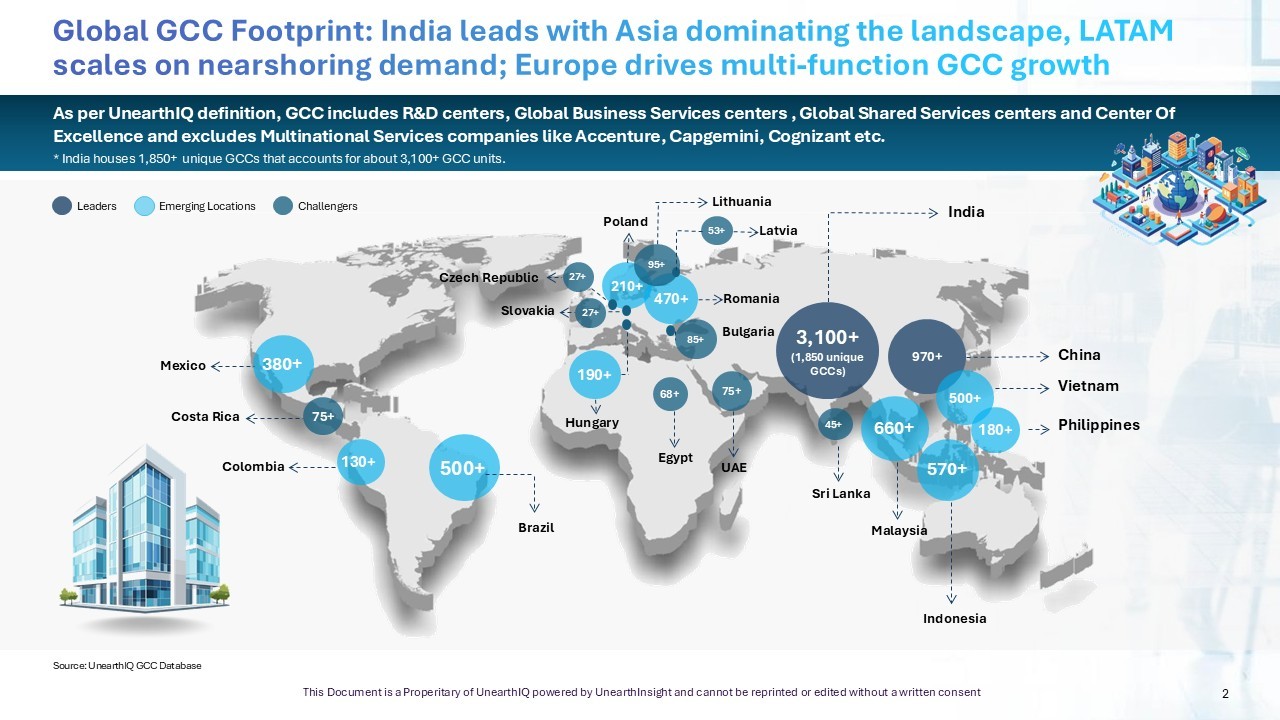
India remains the global anchor with 3,100+ GCC units across 1,850+ unique centres. It offers unmatched scale, a deep digital talent pool, mature ecosystems, and cost competitiveness. Beyond volume, India now hosts complex mandates across product engineering, AI, cybersecurity, data platforms, R&D, and multi-function global operations.
A key differentiator is internal diversity. Southern India leads in product engineering and deep tech, while northern and western India offer strength in BFSI, enterprise tech, and shared services. India effectively combines multiple capabilities within a single large ecosystem, making it suitable for both first-time setups and large-scale expansions.
China: Manufacturing-Linked Strength
China ranks second globally with 970+ GCC units. Its strength lies in proximity to manufacturing ecosystems, hardware-led innovation, and strong government incentives in major tech hubs such as Shanghai and Shenzhen. A large engineering workforce continues to support scale, although language and geopolitical considerations have led many multinationals to complement China with alternative locations rather than rely on it exclusively.
Philippines: Operations and Customer Excellence Hub
The Philippines (180+) continues to play a focused but critical role in global GCC portfolios. It is particularly strong in customer operations, shared services, finance processes, and multilingual support.
Its strength lies in communication skills, cultural alignment with Western markets, and cost efficiency for service-led mandates.
Eastern Europe: Deep-Tech and Regulated Capability Hub
Eastern Europe has emerged as a specialised GCC corridor for deep-tech, cybersecurity, engineering, and regulated industries. While smaller in scale than India, the region offers strong STEM talent, EU regulatory alignment, and proximity to Western Europe.
Romania (470+) anchors the region with scale and depth across enterprise tech, fintech, and health tech.
Poland (210+) stands out for cybersecurity, BFSI, and advanced engineering mandates.
Hungary (190+) remains strong in automotive engineering, enterprise IT, and shared services.
Bulgaria (85+) and Lithuania (95+) are agile digital hubs with growing strengths in fintech, analytics, and product development.
Latvia (53+) supports compact digital and analytics teams.
Czech Republic (27+) and Slovakia (27+) are aligned closely with industrial, automotive, and emerging health tech ecosystems.
Across the region, GCCs typically operate as smaller, high-skilled teams focused on specialised mandates, making Eastern Europe a strong choice for enterprises prioritising regulatory alignment, security-sensitive work, and EU proximity.
Southeast Asia: Diversification and China+1 Strategy
Southeast Asia is increasingly part of enterprise diversification strategies.
Malaysia (660+) and Indonesia (570+) are rising as cost-effective and English-friendly hubs.
Vietnam (500+) is benefiting from strong FDI inflows and a young workforce.
These markets are often positioned as complementary hubs, particularly in China+1 models and resilience-led supply chain strategies.
How Enterprises Evaluate GCC Locations
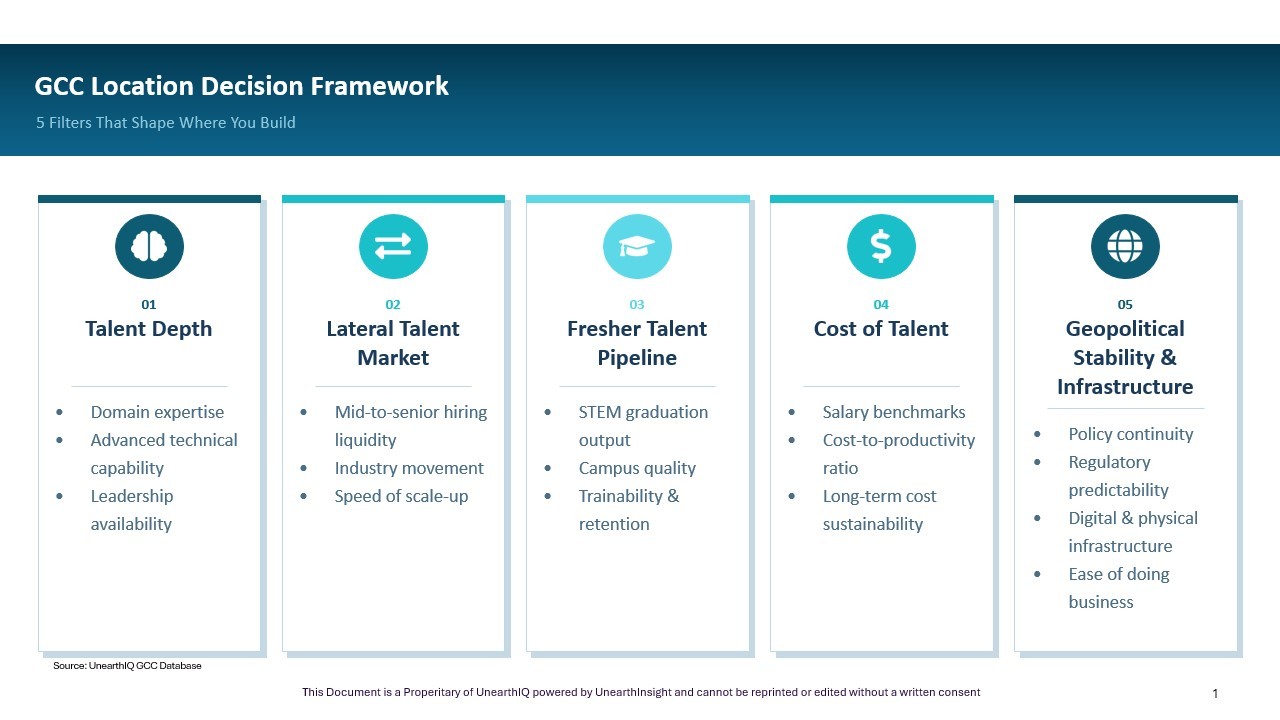
With multiple credible destinations in play, location decisions require a structured lens. UnearthIQ assesses markets across five filters: talent depth, lateral hiring liquidity, fresher pipeline strength, cost-to-productivity ratio, and geopolitical and infrastructure stability. No market wins on all five — the right choice depends on which filters matter most for the mandate at hand.
UnearthIQ view
The global GCC footprint is no longer about defaulting to a single destination. Enterprises today have multiple credible location options, and the right choice depends on mandate complexity, risk appetite, scale ambition, and ecosystem maturity.
India remains central to many global strategies because of its depth and diversity. At the same time, specialised and nearshore markets are increasingly being chosen for focused mandates or as first-entry locations, with expansion strategies evolving over time.
GCC location decisions are becoming portfolio-led rather than volume-led. The emphasis is on aligning work types, growth plans, and long-term operating models to the most suitable ecosystems. UnearthIQ works with enterprises to make that choice deliberately, helping design balanced and future-ready global footprints