
Inside Novartis’ India GCC: How Hyderabad Became Novartis’ Largest Site Outside Basel
GCC InsightCircle Series | Week 3 - By Sanath Manjunath Nadig
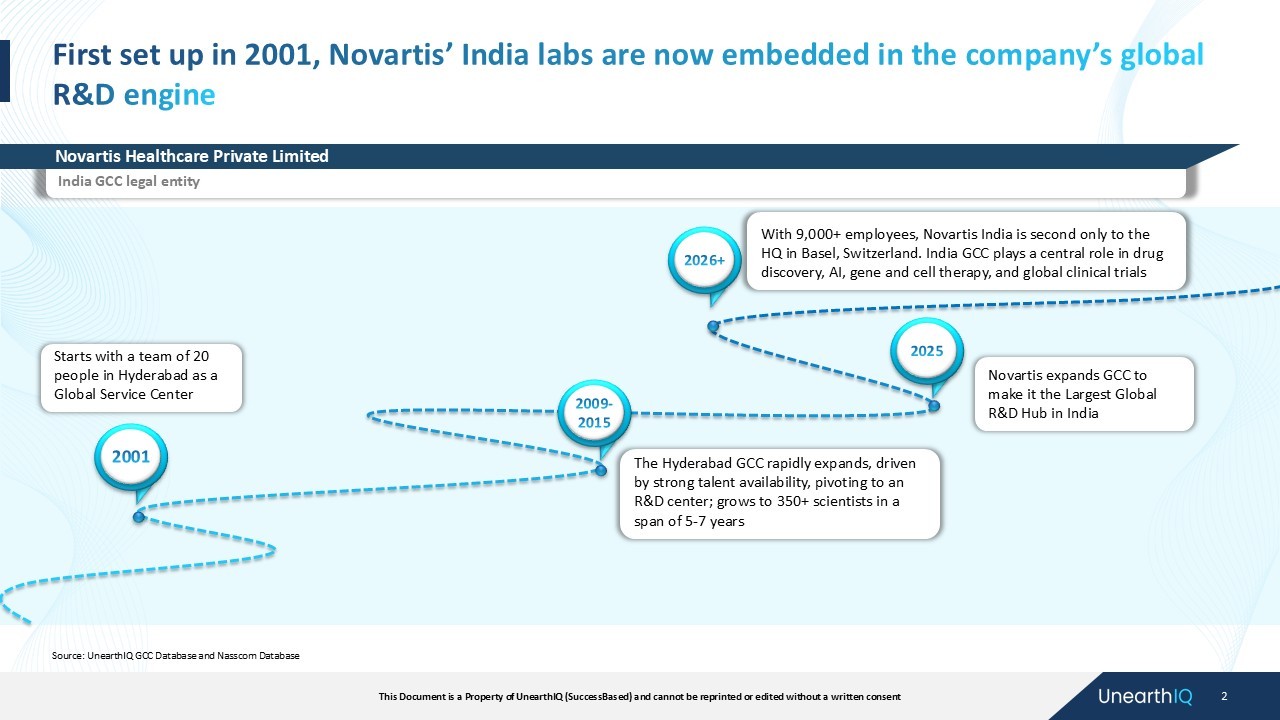
Novartis opened its first office in Hyderabad in 2001 with a team of 20, set up as a small Global Service Center. Nearly three decades later, Novartis Healthcare Private Limited is the company’s largest site outside its Basel headquarters, with 9,000+ employees, three operating pillars, and ownership of functions spanning drug discovery, biomedical research, and global drug safety. The Hyderabad GCC is a useful case study in how a pharma Global Capability Center in India can evolve from a support center into a global R&D hub.
Founded: 2001
Legal name of GCC Entity: Novartis Healthcare Private Limited
Revenue/Transfer Pricing (FY25): ~$703 Mn (₹ 6,007 cr)
The Novartis India GCC Journey
Novartis’ India operation began in Hyderabad in 2001 much like a back-office centre. Between 2009 and 2015, the center moved from shared services to an R&D-led model and scaled to 350+ scientists in five to seven years. Over this period, the GCC also broadened its scope across marketing analytics, salesforce planning, incentive design, competitive intelligence, and launch strategy.
In 2025, Novartis expanded the Hyderabad GCC into its largest global R&D hub in India. Headcount is now above 9,000 across drug discovery, AI and machine learning, gene and cell therapy, and global clinical trials. India is now Novartis’ second-largest site globally after the Basel headquarters in Switzerland.
Scale and Scope of the India GCC
Operational scale
Around 90% of Novartis’ global drug safety operations are managed from Hyderabad. The Novartis Corporate Center (NOCC) India is the largest of Novartis’ six global corporate centers and supports HR, Finance, IT, Regulatory, and Quality functions for 100+ countries. Hundreds of active global clinical trials across oncology, cardiovascular, neuroscience, and gene therapy are run from India, alongside global ERP and IT transformation work.R&D and functional ownership
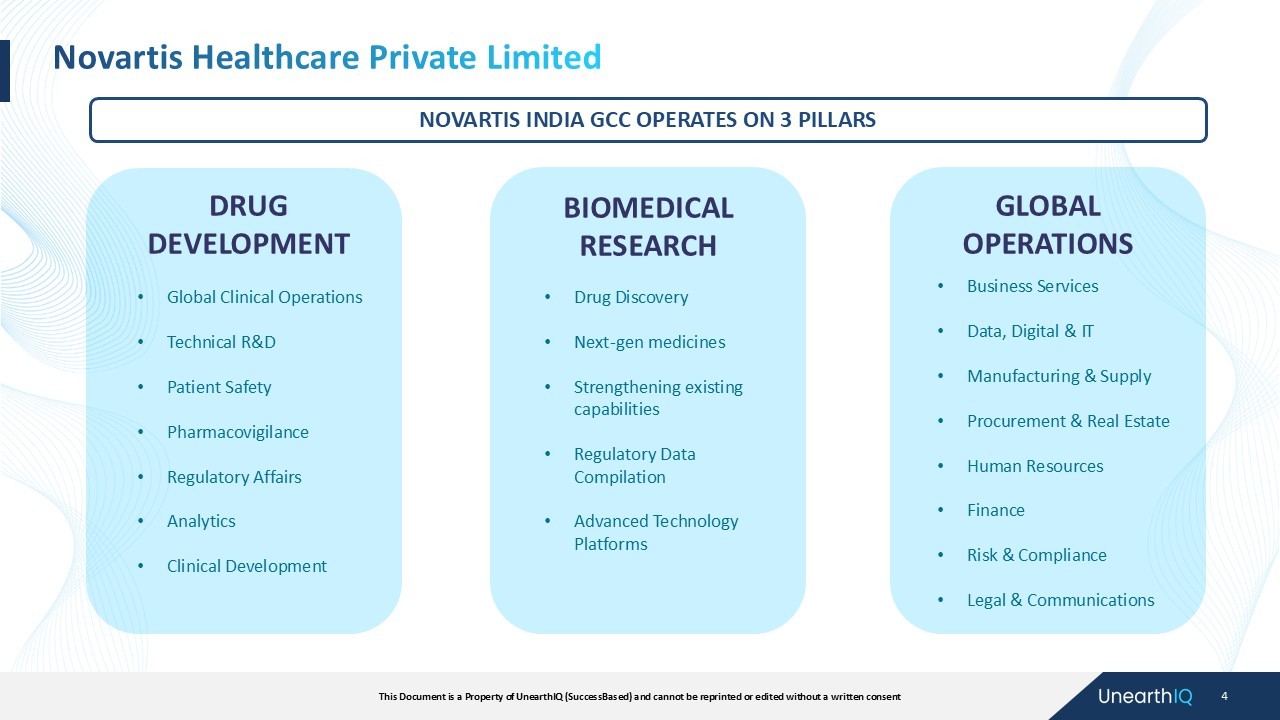
Novartis Healthcare Private Limited operates on three pillars: Drug Development, Biomedical Research, and Global Operations. The Drug Development pillar covers global clinical operations, technical R&D, patient safety, pharmacovigilance, regulatory affairs, and analytics. Biomedical Research is anchored by a 200+ member team of PhDs and scientists in chemistry, biochemistry, and clinical research, with 3,000+ scientists, physicians, and professionals overall working on drug development from India.
70-80% of Novartis’ global quality professionals are based in the Hyderabad GCC, and Global HR Operations runs with 400 specialists covering rewards, skill development, and employee relations. Global Operations also covers data, digital and IT, manufacturing supply, procurement and real estate, finance, risk and compliance, and legal and communications.Leadership
Amitabh Dube is Country President and Managing Director. Ganpat Anchilya is Site Head of the Novartis Corporate Centre, Hyderabad. Atul Tiwari is Site Head of Biomedical Research. Saravana Krishnan is Country HR Head.
The AI Agenda
Novartis has stated a public objective of using AI to halve drug development timelines. The Hyderabad GCC sits at the center of the company’s “AI-First R&D” approach. The India-anchored AI portfolio covers four areas:
AI-driven drug discovery uses ML models for target identification, molecular screening, and biomarker analysis, in collaboration with global R&D teams.
Medical imaging AI applies deep learning to radiology image analysis in oncology clinical trials, developed and operated from Hyderabad.
Drug safety AI runs real-time adverse event signal detection and automated pharmacovigilance reporting across 100+ markets.
Commercial GenAI uses LLM-powered tools for competitive intelligence, launch strategy simulation, and medical information Q&A, deployed globally from India.
Takeaways for GCC Leaders
• R&D-led expansion. The shift from a service center to an R&D hub is what allowed Hyderabad to become the second-largest Novartis site globally. Ownership of drug discovery and pharmacovigilance changes the GCC’s role inside the parent organization.
• Concentration of quality and safety functions. With 70-80% of global quality professionals and around 90% of drug safety operations based in Hyderabad, the India GCC holds capabilities that are difficult to relocate.
• Co-location of scientific and AI talent. Drug discovery ML, medical imaging AI, and pharmacovigilance AI are run from one location because the scientific and AI teams sit alongside each other.
• Long investment horizon. The 9,000-person, R&D-led GCC is the result of sustained investment in talent, infrastructure, and scientific capability over nearly three decades.
What's Next
With AI positioned as a primary lever for Novartis’ drug development acceleration, and Hyderabad now the company’s largest global R&D hub in India, the next chapter for the India GCC is likely to focus on scientific and AI velocity rather than headcount growth. The “AI-First R&D” strategy, the global ownership of drug safety, and the breadth across drug development, biomedical research, and global operations define the operating model going forward.
This is part of our weekly GCC Spotlight series, where we examine the journey, scale, and strategy of leading Global Capability Centers in India.