
Inside Microsoft India R&D Center: How India Became Microsoft's Largest R&D Hub Outside Redmond
GCC InsightCircle Series | Week 1 - By Sanath Manjunath Nadig
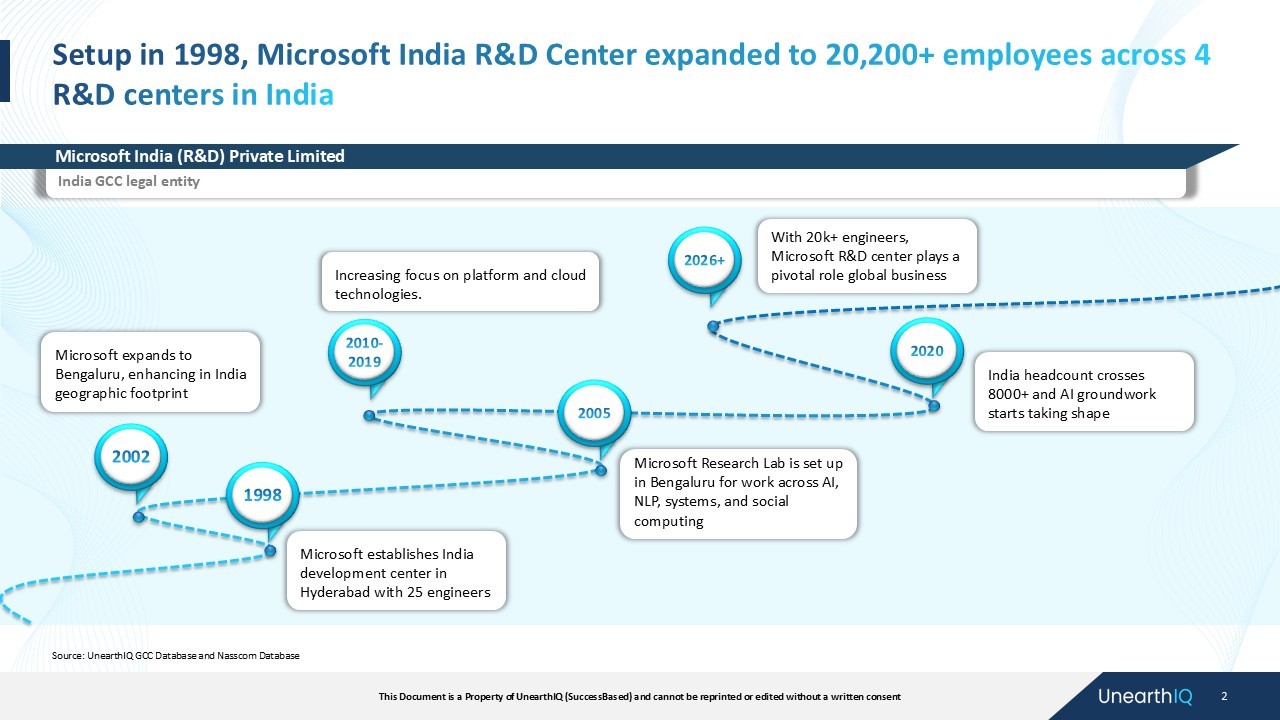
When Microsoft set up shop in Hyderabad in 1998 with around 25 engineers, very few people expected it to become the blueprint for what a Global Capability Center in India could look like. Almost three decades later, the Microsoft India R&D Center (then called the India Development Center - IDC) is the company's largest R&D footprint outside Redmond. For any GCC leader thinking about scale, maturity, and real product ownership, this is a story worth studying closely.
Legal name of India GCC - Microsoft India (R&D) Private Limited
Total employees -20,180+ employees
Transfer Pricing (FY25) - $2 Bn (₹ 19,100 Cr)
From Cost Center to Co-Owner: The Microsoft Center Journey
The Microsoft R&D story mirrors how GCCs in India have grown up over the years. What started as back-office support has slowly turned into global product co-ownership. Today, Microsoft runs its R&D across 4 R&D campuses (Hyderabad, Bengaluru, Noida, Pune) and with a $1.2 Bn+ loaded wage bill.
Why Microsoft R&D Matters for the GCC Conversation
Three things make Microsoft R&D a reference point for almost every GCC strategy conversation.
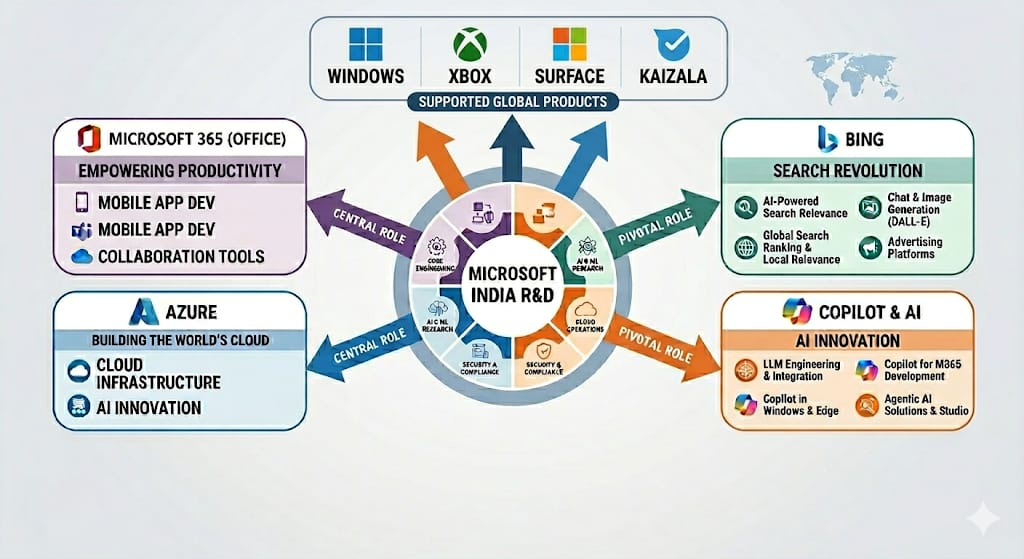
1. Full product ownership, not staff augmentation. The GCC runs the entire cycle, from research to engineering to product ownership and global support. Microsoft 365, Copilot, Azure AI Search, GitHub Copilot, Dynamics 365, and Bing all carry serious India engineering DNA. Kaizala was built in India. Sprightly grew into what is now Microsoft Designer.
2. AI leadership, not just AI participation. India ranks 5th globally in GenAI inventions, growing at a 56% CAGR, which is the fastest in the world. Copilot Studio, AI Agents, and Azure AI Search are run as global engineering hubs out of India. India is also among the top 4 global markets for Microsoft 365 Copilot in-country data processing in 2025.
3. Real leadership density. More than 100 Global Partners, Principals, and product owners sit at Microsoft’s India GCC. Rajiv Kumar, Sriram Rajamani, and Dahnesh Dilkhush anchor a leadership tier that owns global P&Ls, not just regional ones.
The Strategic Takeaway for GCC Leaders
Microsoft R&D backs up a view that is now becoming common sense. The next decade of GCC value will not come from cost arbitrage. It will come from IP ownership, AI capability, and full-stack product accountability.
A few patterns are worth holding on to:
Long-term investment compounds. Microsoft’s capabilities haven’t developed overnight. It’s suite of products and applications sit on 27 years of patient capability building.
Research labs are strategic moats. Microsoft Research India feeds work in responsible AI, code-mixed language models, and the ELLORA project for low-resource Indian languages. All of it flows back into Teams, Azure, and Copilot.
Sovereign-ready infrastructure is the new edge. Three new Azure regions and hyperscale data centers in India put the GCC at the meeting point of global engineering and local sovereignty needs.
What's Next
India continues to co-build products, platforms, and AI solutions for global enterprises; however, as a market, it is expected to be a growth driver for Microsoft, and it has committed $17.5 Bn to AI and Cloud.
· Microsoft India R&D center will play a pivotal role in building products, solutions, and platforms for Indian enterprises.
· Microsoft GCC/ R&D center has created a playbook for global enterprise tech product firms to learn, adopt, and build a global co-owner mindset.
· UnearthIQ tracks critical financial, operational, and talent metrics for new Greenfield GCCs and existing Brownfield GCCs to learn from.
This is part of our weekly GCC InsightCircle series, where we look at the journey, scale, and strategy of leading Global Capability Centers in India.
Talk to our analysts and the leadership team to baseline, benchmark, and transform your GCC in India.