
Inside HSBC's GCC in India: How a Dual-Entity Model Powers a Global Bank
GCC InsightCircle Series | Week 2 - By Sanath Manjunath Nadig
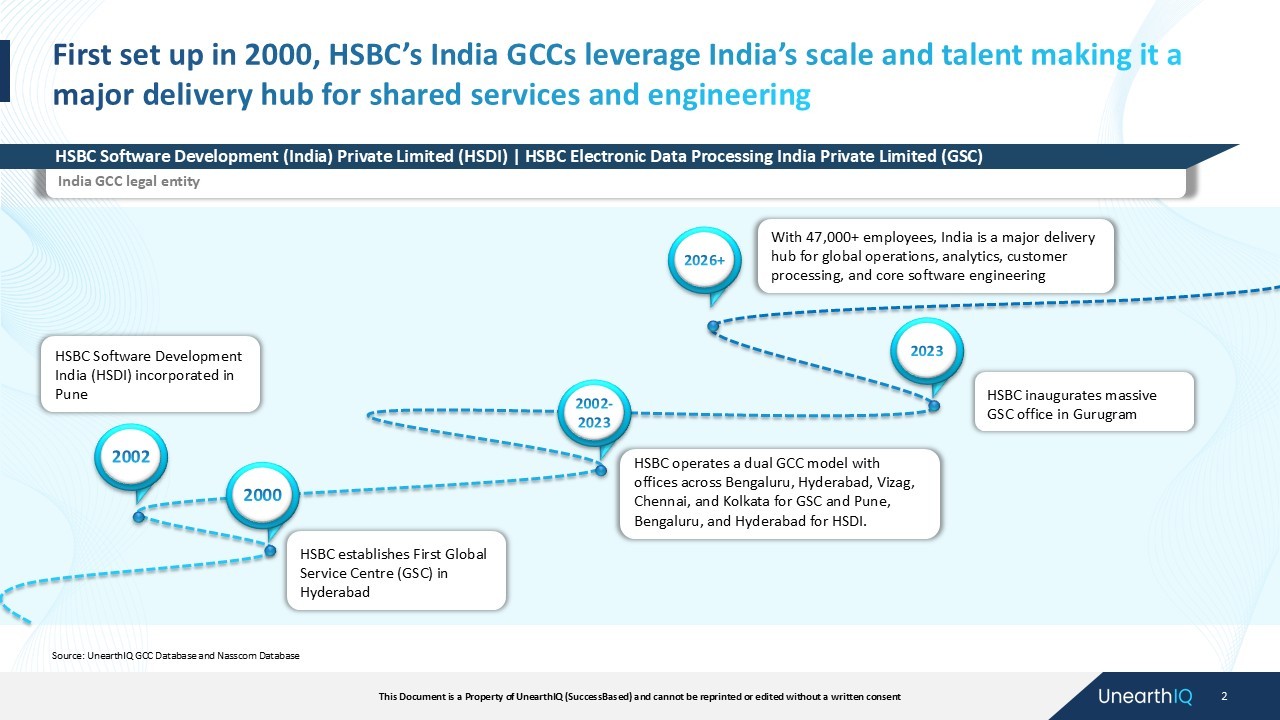
HSBC's India GCCs have grown from a single Hyderabad service center in 2000 into a 47,000-strong, dual-entity operation generating roughly $2.54 billion in FY25 transfer-pricing revenue. Today, they sit at the core of HSBC's global technology, operations, and AI strategy, a benchmark for what a mature financial-services GCC looks like at scale.
Legal names of both India GCC entities: HSBC Software Development (India) Private Limited (HSDI) and HSBC Electronic Data Processing India Private Limited/Global Services Center (GSC)
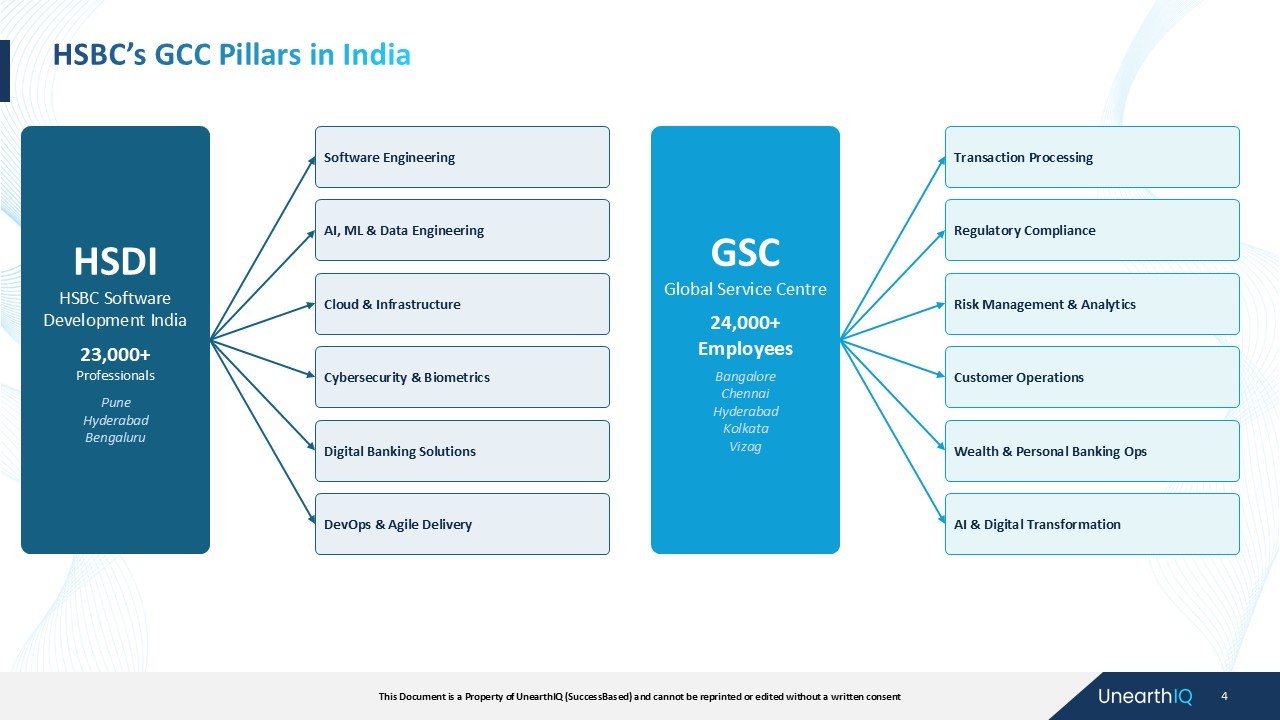
Employees – 47K+ (24K+ GSC, 23K+ HSDI)
Transfer Pricing (FY25) - $2.54 Bn (₹21,724 cr) – Across both GCC entities
HSBC's India GCC Journey: From Shared Services to Global Delivery
HSBC opened its Global Service Center (GSC) in Hyderabad in 2000 to scale processing and operational support. In 2002, it set up HSBC Software Development India (HSDI) in Pune as a separate legal entity focused on software engineering and platform delivery. The dual-entity structure: HSDI for engineering, HSBC EDPI for operations and analytics, is unusual among Indian GCCs and reflects a deliberate separation of accountability across talent, leadership, and operating models.
Why HSBC's GCC Model Stands Out
Global-Scale Operations, Not Just Large Headcount
The India GSC processes 1.7 trillion customer transactions a year at 380 payments per second, supporting HSBC's 39 million customers across 57 countries. Payments, regulatory compliance, trade finance, capital markets, securities, and custody all run through it.Full-Stack Technology Ownership
HSDI's Pune, Bengaluru, and Hyderabad teams own most of HSBC's global software ecosystem, wholesale banking platforms, retail digital apps, and payment rails. Teams operate in agile DevOps pods with end-to-end delivery accountability. The Group Data & Analytics Technology (GDT) function, a CIO-level unit spanning 12 countries, is anchored in India.Senior Leadership with Global Remits
Pradeep Menon leads HSDI as MD & CEO and heads the HSBC Tech Center India. Mamatha Mandireddy runs the Global Service Centers. Chandrashekhar Meled is CTO for HSDI, and Mahadev Amaravadi leads Business Management and CTO responsibilities across GDT, both global mandates, not regional ones.
AI Is HSBC's Biggest 2026 Bet, and It Runs Through India
HSBC has named GenAI as its single-largest technology investment for 2026, with India as the execution engine. 85% of HSBC's 200,000+ global employees now have access to GenAI tools, many of which are built and operated out of the India GCCs.
An AI Center of Excellence within HSDI anchors the bank's responsible-AI governance framework. Use cases span fraud detection, credit decisioning, client personalization, AI-assisted coding, and cloud-native banking infrastructure, all tied to the CEO's 17%+ RoTE target for 2026–28.
Four Takeaways for GCC Leaders
Dual-entity structures create accountability at scale. Separating engineering from operations lets each function build its own talent and leadership bench.
Owning infrastructure means owning influence. GCCs that run payment rails and core platforms carry strategic weight that's hard to relocate.
AI governance is the new differentiator. An AI CoE with responsible-AI guardrails compounds over time, harder to build than tools, harder to copy.
Long horizons produce outsized returns. Twenty-five years of compounded investment is what makes a $2.54 Bn GCC possible.
What's Next
With GenAI as the primary lever behind HSBC's RoTE targets through 2028, the India GCCs are shifting their focus from headcount growth to depth of capability per engineer. The GDT global-ownership model, the AI CoE, and two decades of engineering investment position HSBC's India centers to lead the next chapter of financial-services GCCs.