
India GCCs: The Strategic Lever for German Competitiveness
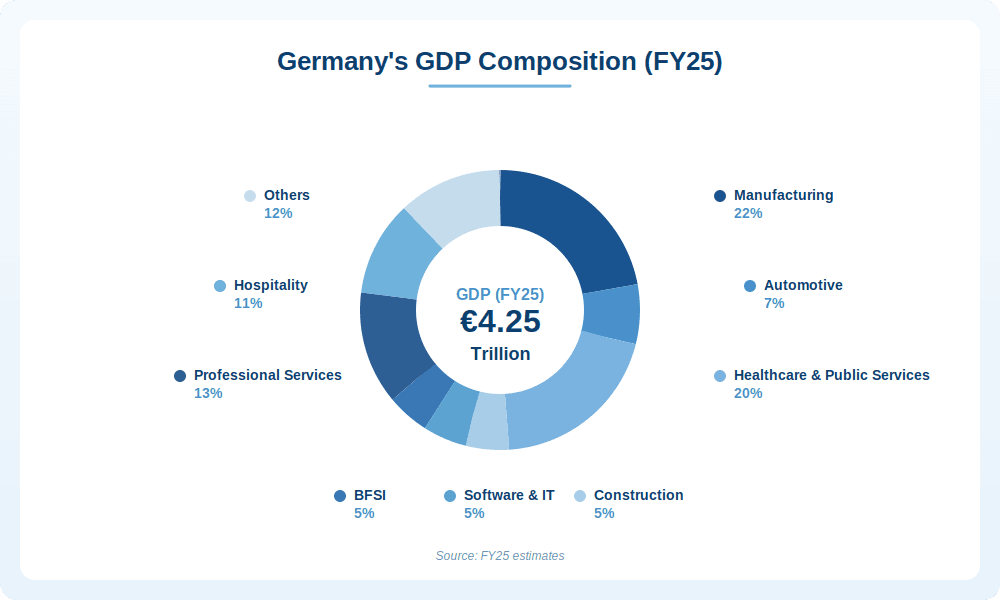
Germany enters 2026 as the world’s third-largest economy, with a nominal GDP of ~€4.25 trillion and a strong global footprint across engineering, automotive, manufacturing, technology, and BFSI. Its industrial depth, Mittelstand strength, and export orientation remain its core advantages.
Yet, the structural pressures are building; hence, how the German companies respond will shape their competitiveness over the next decade. One strategic lever gaining traction is looking beyond domestic borders to access talent, scale, and innovation.
The Challenge Landscape
Talent constraints - An aging population has led to acute shortages of skilled and digital talent. As of 2025, Germany faces a deficit of 100,000+ IT experts, 30,000+ mechanical and automotive engineers, and an overall skilled labor shortage of around 400,000. Nearly 60% of companies report gaps in digital capabilities that directly affect their transformation agendas.
Economic headwinds - Consecutive years of GDP contraction have raised concerns about stagnation. Competitive manufacturing is shifting to faster-growing regions, eroding traditional cost and speed advantages.
Regulatory and cost pressures - Bureaucratic complexities have introduced inefficiencies. Stringent data compliance requirements have hampered innovation, and high energy prices have increased operating costs. The Mittelstand—which employs over 54% of Germany’s workforce and forms over 99% of all German enterprises—is under growing strain.
Together, these factors are tightening margins and slowing innovation cycles.
Why India Matters for German Enterprises
Over the past decade, India has emerged as a strategic destination for Global Capability Centers (GCCs). What began as cost-focused offshore delivery has evolved into a model that supports product development, digital transformation, and R&D at scale.
The India Value Proposition for German Enterprises
Infrastructure and digital readiness- India continues to add high-quality commercial real estate, with GCCs driving 37–40% of all commercial leasing in 2025. The country combines large-scale transport infrastructure with deep digital penetration, enabling distributed and scalable operations.
Depth of technical talent- India has 1.5 million+ engineering professionals and produces 300,000+ industry-ready IT graduates every year. The AI/ML talent pool: over 400,000 and growing at 21% annually, gives German companies access to skills increasingly scarce in Europe.
Skill-to-cost advantage- A 100-member team in India can be built at 57% of the cost of a similarly skilled team in Germany. This enables reinvestment into innovation, R&D, and new capabilities.
Regulatory familiarity and energy advantage- India’s Digital Personal Data Protection (DPDP) Act aligns with global norms, providing regulatory certainty for European firms. Lower energy costs further support efficiency, especially for digital and engineering-intensive functions.
These factors position India as a long-term capability partner, not a short-term cost play.
German GCCs in India: From Support to Strategic Core
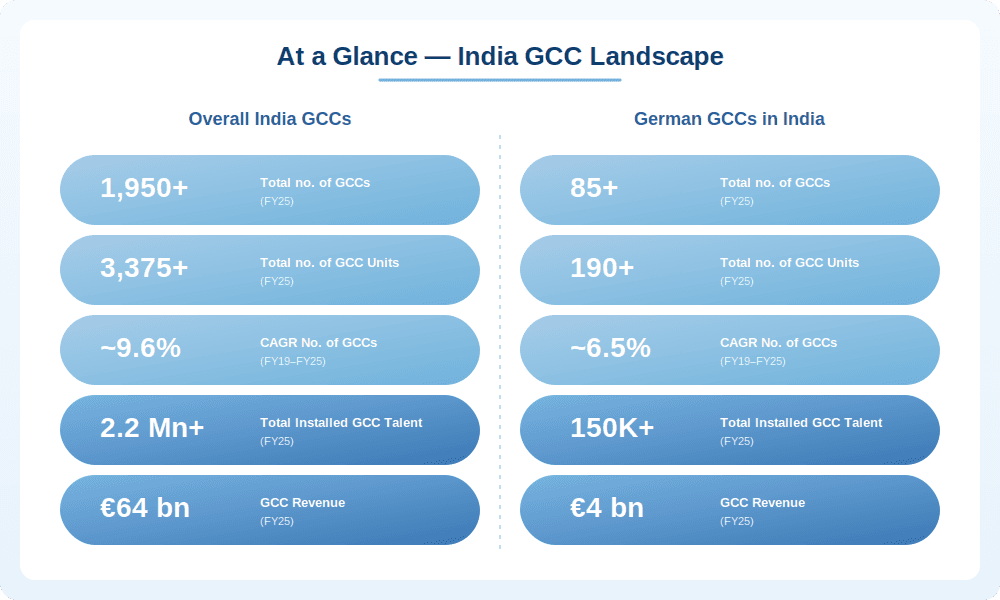
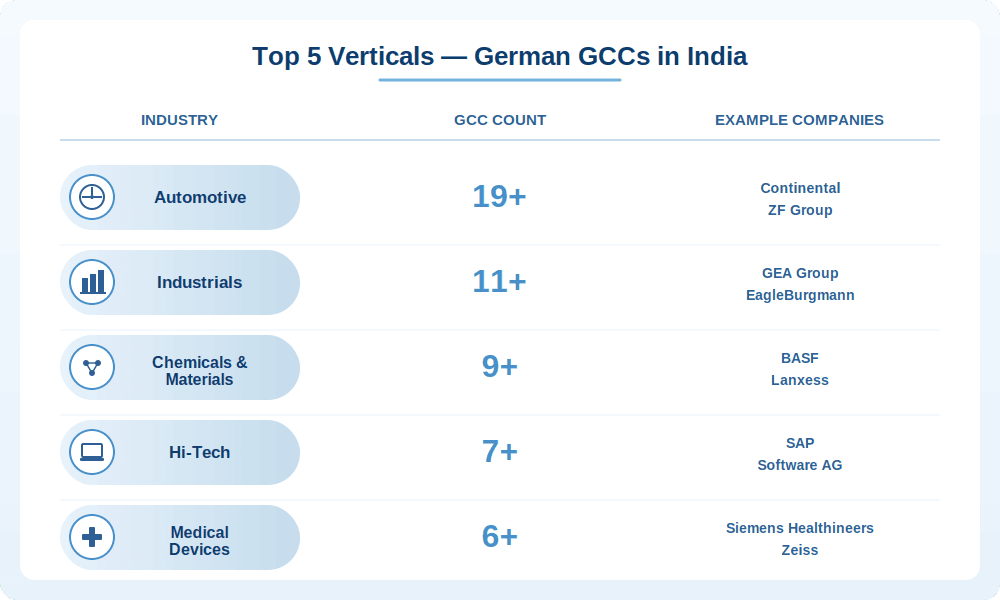
Over 85 German companies, led by automotive, industrial manufacturing, software, and BFSI, already operate GCCs across India. These centers have evolved from back-office units into hubs for:
• Product engineering and embedded software
• Industry 4.0, AI, and data platforms
• Enterprise IT transformation
• R&D and global innovation programs
• Shared services unifying global HR, finance, and legal processes
Location Hotspots and Functional Depth
Bengaluru and Pune house ~80% of AI/ML talent serving German GCCs, dominating automotive and engineering R&D operations. Hyderabad has emerged as a preferred hub for BFSI and telecommunications, while Coimbatore is gaining traction for manufacturing engineering. German GCCs have a strong 56% concentration of talent in ER&D functions, underscoring their engineering-heavy nature.
GCC Maturity
~46% of German GCCs in India have matured into “Portfolio Hubs” with end-to-end ownership, global mandates, and innovation leadership. This reflects the ecosystem’s transition from cost-optimization to value-driven operations.
Mittelstand Momentum
Over 28 Mittelstand companies now operate 37+ GCC units in India. These are primarily concentrated in Pune and Bengaluru, employing 7,300+ engineers and representing 31% of all German GCCs.
Innovation Through Collaboration
57% of German GCCs partner with Indian universities and startups to co-develop next-gen capabilities, creating a collaborative innovation ecosystem. 34% of German GCCs view startup partnerships as a strategic way to speed up innovation and achieve faster time-to-market.
GCC Success Stories: How German Giants Are Winning in India
Mercedes-Benz (Automotive): Mercedes-Benz’s India GCC is its largest development hub outside Germany. The center drives digital innovation and vehicle engineering through cutting-edge CAD/CAE, embedded systems, and telematics. With over 7,000 engineers and 500+ patents, it contributes critical software, electrical, and mechanical engineering expertise to every vehicle in the global portfolio.
Deutsche Bank (BFSI): Deutsche Bank’s India technology hub employs 18,000+ engineers across Mumbai, Bengaluru, Pune, and Jaipur—45% of its global tech workforce. As its largest innovation center globally, the hub drives digital transformation through next-generation AI, cloud computing, and ML solutions. The GCC has evolved from a service provider into a key asset, pioneering proprietary technologies that shape the bank’s worldwide digital future.
Deutsche Telekom (Telecommunications): With 250 million+ users across 50+ countries, Deutsche Telekom has turned its India GCC into a strategic innovation hub. A team of 1,000+ experts adds value through AI, IoT, and cloud-led solutions while advancing automation, cybersecurity, digital transformation, and 5G capabilities across the company’s global network infrastructure.
These success stories underscore a critical shift: German GCCs in India are no longer auxiliary units. They are innovation engines driving growth alongside headquarters teams.
The Way Forward for German Companies
GCCs today offer not only cost-efficiency and scale but are also becoming a critical strategic stabilizer for MNCs navigating a volatile geopolitical landscape. India’s GCC ecosystem is now among the most mature globally, and the country is projected to host 2,500+ unique GCCs by 2030.
For German enterprises, the question is no longer whether to engage with India, but how. Successful models combine:
• Phased GCC entry with clear mandates and expansion aligned to business priorities
• Strong governance and integration with HQ and other global teams
• Strategic partnerships, M&As, and collaborations with local academia, startups, and ecosystem players
India offers German companies a practical path to scale skills, accelerate digital agendas, and future-proof operations. As global competition intensifies, leveraging India’s GCC ecosystem can help German enterprises sustain innovation and stay competitive in a rapidly changing global economy.
The cost of inaction is rising. Talent shortages, slower transformation, and structural cost pressures will continue to challenge German competitiveness.