
India as a strategic GCC destination for Australian companies
Australia remains one of the world’s strongest advanced economies, with a 2025 GDP of AUD 2.7 trillion and a business landscape led by services, retail, and hospitality, which together contribute more than 75% of total economic value added. SMEs account for more than 99% of all firms and over 65% of employment, while large enterprises continue to drive innovation across Software and IT, Energy, BFSI, and Telecommunications.
Yet these strengths are increasingly accompanied by structural constraints. Australia is expected to face a tech talent shortage of around 300,000 by 2030, including a shortfall of more than 200,000 AI and ML professionals, with an estimated AUD 16 billion economic impact. At the same time, a population of around 27 million limits the scale of the domestic talent pool, while 1.5% population growth in 2024–25 was driven largely by immigration, making labour market expansion more uncertain.
Why GCCs matter now
For Australian enterprises, Global Capability Centres are no longer only a delivery model. They have become a strategic lever to access talent, strengthen execution capacity, and sustain transformation momentum despite domestic constraints.
The core leadership question is therefore not whether to establish a GCC in India, but how to define the right mandate from the outset. A well-scoped GCC can create long-term value by improving resilience, expanding capability, and supporting growth at scale.
India’s GCC scale and maturity
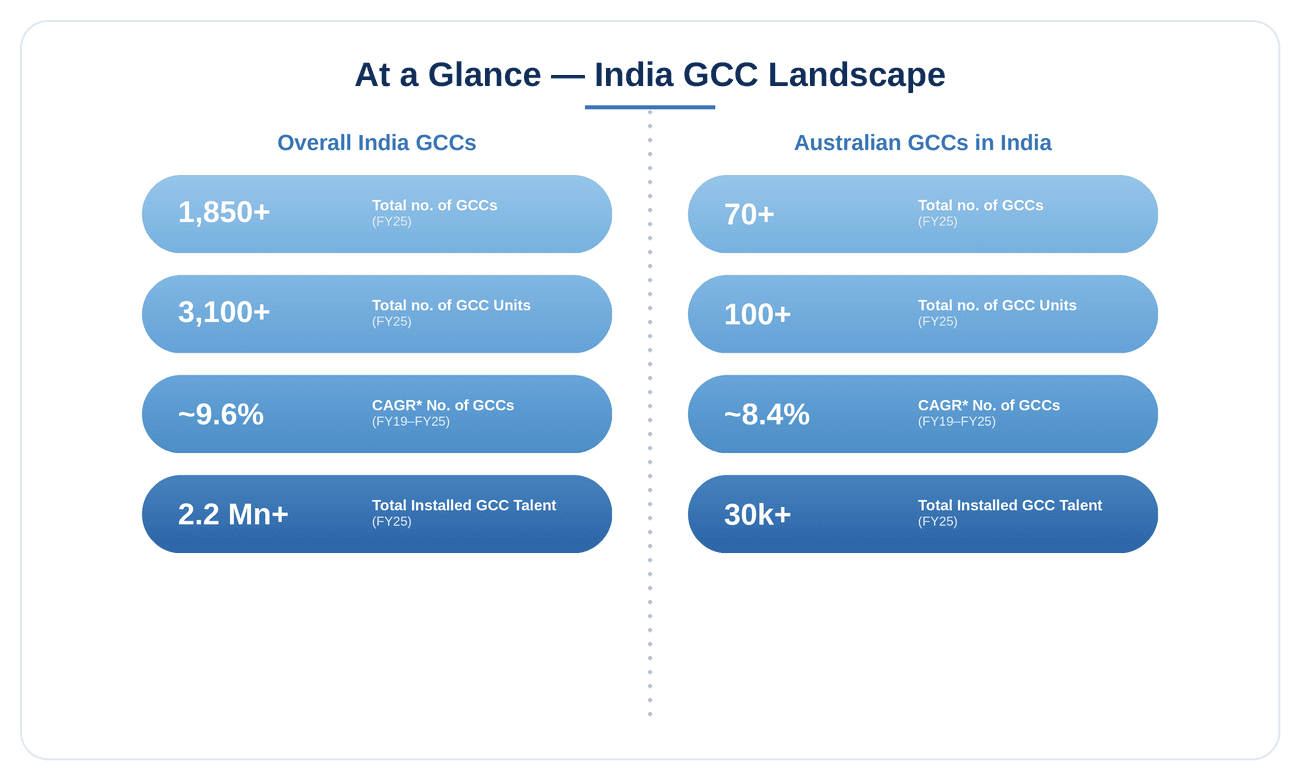
The scale is significant. India now hosts more than 3,100 GCC units across over 1,850 global enterprises, with a market size of around AUD 108 billion in 2025, projected to reach around €140 billion by 2030. New GCC setups have grown at a CAGR of approximately 9.6% over the last five years, while employment has expanded to more than 2.2 million professionals and is expected to exceed 3 million by 2030.
Australia’s GCC footprint in India
Australian companies are already building a meaningful presence in India’s GCC ecosystem. More than 100 GCC units have been established by over 70 multinational corporations, growing at a CAGR of around 8.4% over the past five years and employing more than 30,000 professionals.
This footprint is concentrated in sectors where Australian firms have strong global relevance. BFSI accounts for around 45% of Australian GCC activity in India, followed by Energy at 25%, Telecom and IT at 10%, and Healthcare at 10%.
The India value proposition
India has evolved into a leading destination for Global Capability Centres over the past decade. What began as a cost-focused offshore model has matured into a strategic platform for product development, digital transformation, and R&D.
The country offers Australian companies a combination of scale, talent, infrastructure, and operating efficiency. High-quality commercial real estate continues to expand, with GCCs driving 37–40% of all commercial leasing in 2025, supported by strong transport networks and deep digital penetration.
The talent proposition is equally compelling. India has more than 1.5 million engineering professionals and produces over 300,000 industry-ready IT graduates annually. Its AI and ML talent pool, already above 400,000 and growing at an annual rate of 21%, gives Australian firms access to skills that are becoming increasingly difficult to secure domestically.
The economic case is also clear. A 100-member team in India can be built at roughly 35% of the cost of a similarly skilled team in Australia, allowing organisations to redirect capital towards innovation, R&D, and strategic capability building. India’s DPDP Act also provides greater regulatory familiarity, while lower energy costs support efficiency in digital and engineering-intensive operations.
Industry opportunities
The opportunity is strongest in sectors where Australia already has scale and competitive depth.
In Pharma and MedTech, India’s manufacturing strength, regulatory depth, and R&D capabilities make it a valuable partner for Australian biotech and healthcare firms. In BFSI, India’s digital payments ecosystem, engineering talent, and open API environment create opportunities in core banking, payments, and financial platforms.
In Technology and SaaS, India’s ecosystem of more than 900 hi-tech GCCs offers the depth needed for offshore product development, engineering, and innovation. In Mining and Energy, capabilities in IoT, analytics, embedded systems, and predictive maintenance can help Australian firms modernise engineering-heavy operations.
Illustrative success stories
Australian companies are already using India-based GCCs for work that sits close to the core of enterprise value creation.
In the BFSI sector, ANZ has built GCCs in Bengaluru and Hyderabad with more than 7,000 engineers, who now support over 60% of the bank’s global technology and process landscape. These centres play a central role in core banking platforms and real-time payments, demonstrating how a GCC can evolve from support delivery into a strategic technology backbone.
In healthcare technology, ResMed’s India technology centre has helped accelerate the development of digital diagnostics, remote monitoring tools, and AI-enabled therapy management. This illustrates how India can serve not only as an execution base, but also as an innovation hub supporting global product and patient outcomes.
Location priorities
Bengaluru, Hyderabad, and Pune are the leading destinations for Australian GCCs, together accounting for more than 80% of GCC units. Each city offers a distinct operating advantage.
Bengaluru is the leading technology and innovation hub, Hyderabad has strong depth in healthcare and pharma, and Pune has emerged as an important base for ER&D and manufacturing-led operations. Chennai also remains relevant for engineering and industrial capability builds.
Looking ahead: A practical approach to GCC establishment
The most effective GCCs are built in phases. Australian companies should begin with a clear initial mandate aligned to business priorities, supported by strong governance and close integration with headquarters and global teams.
As the model matures, organisations can scale delivery, expand into adjacent functions, and gradually move into higher-value work such as platform modernisation, data products, cybersecurity engineering, and GenAI-led transformation. Over time, the GCC can become a strategic enterprise asset that drives productivity, innovation, and long-term capability creation.
Strategic implication for Australian CXOs
The case for India is no longer defined by cost alone. It is about building a scalable and resilient capability engine that gives Australian companies access to talent, execution capacity, and transformation muscle that may be difficult to create domestically.
For CXOs, the priority is to approach India with a clear charter, realistic governance, and a phased scaling model. Companies that do this well can turn their GCC into a durable source of competitive advantage.