
Offshore Outpost to Global Office: The Evolution of R&D Centres in India
The story of India’s technology capability centres is one of the most consequential transformations in global business over the past four decades. What began as a cost-driven experiment by a handful of pioneering multinationals has evolved into a strategic imperative for enterprises worldwide. To understand where we are headed, it helps to understand how we got here.
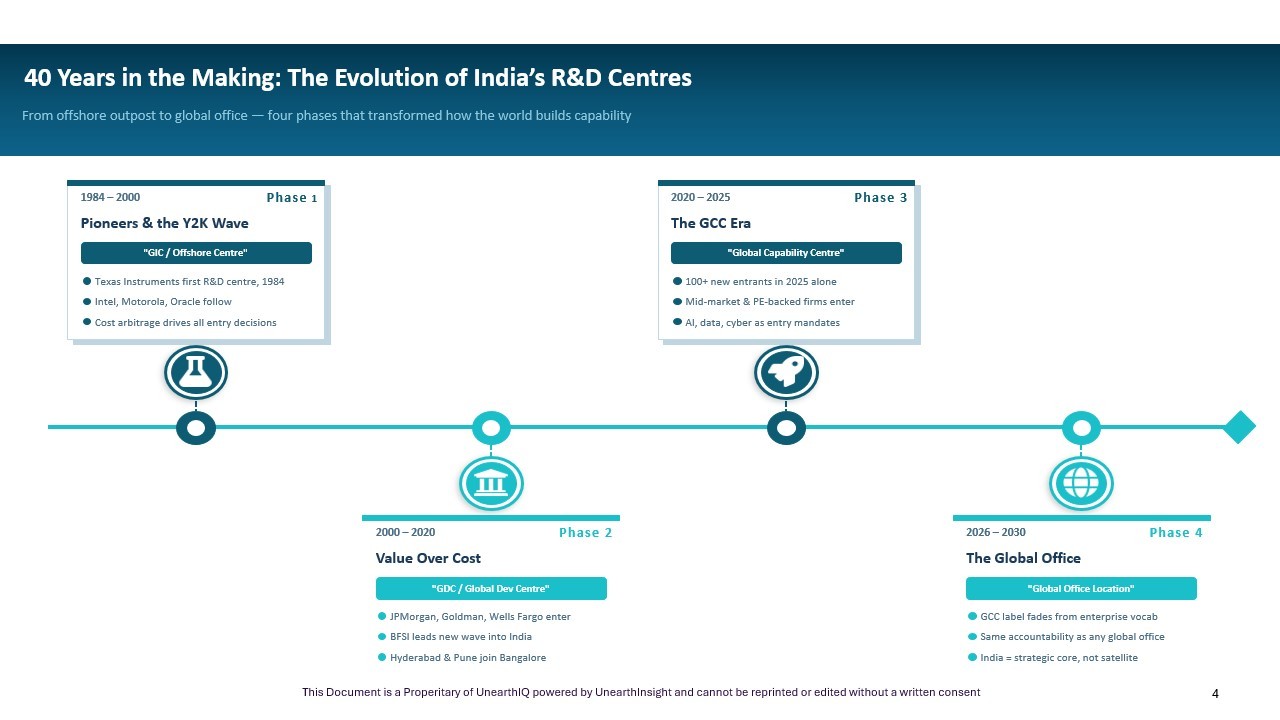
Phase 1: The Pioneers and the Y2K Wave (Late 1980s – Early 2000s)
The story begins in 1984, when Texas Instruments made a decision that would quietly change the trajectory of Indian technology and talent. It set up what is widely recognised as India’s first corporate R&D centre in Bangalore, years before the outsourcing wave. The choice of Bangalore was deliberate: the Indian Institute of Science, a cluster of engineering colleges, and a nascent but high-quality technical talent base made the city a natural home for research-intensive work.
That instinct proved prescient. Through the late 1980s and into the 1990s, a small cohort of technology pioneers followed, including Intel (1984), Motorola (1989), and Oracle (1993), among them, building their own R&D centres in Bangalore and establishing the idea that India could execute serious technical work, not just support functions.
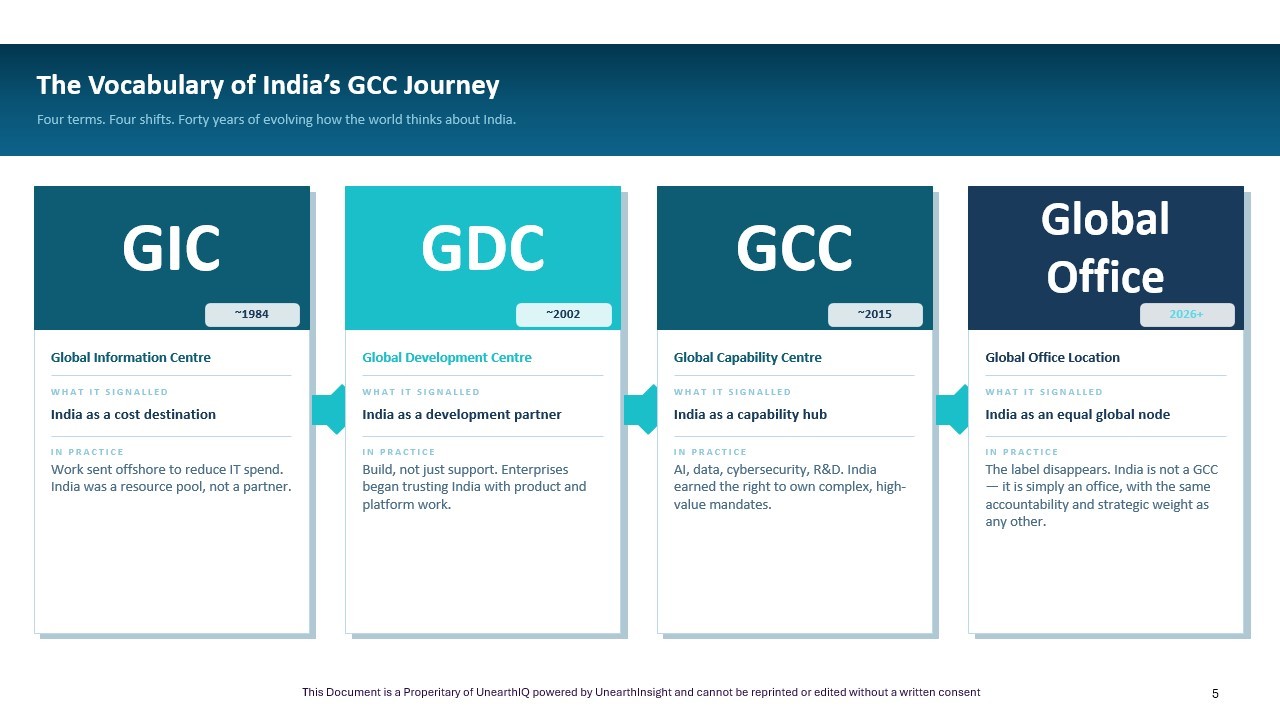
The broader market, however, was dominated by outsourcing. India’s large IT services companies, such as Infosys, Wipro, and HCL, grew rapidly as global enterprises sought to reduce technology costs and leverage India's cost arbitrage. Demand peaked in the late 1990s, driven by the Y2K problem: virtually every technology system worldwide needed to be reviewed, tested, fixed, or replaced, and India’s engineering talent became indispensable. The terms “GIC (Global Information Centre)” and “Offshore Centre” entered the global IT vocabulary during this period. Business cases were built almost entirely on cost arbitrage.
Phase 2: Value Over Cost — The Institutional Build-Out (Early 2000s – 2020)
The early 2000s marked a turning point. Conversations began shifting from “how much can we save” to “what can we build.” A more diverse set of enterprises entered India, not just technology companies, but banks, financial institutions, retailers, and professional services firms.
The financial services sector led this wave. In 2002, JPMorgan Chase established its Global Business Center in Mumbai, one of the early large-scale R&D operations by a major US bank. It signalled that India was ready for complex, regulated, high-value work, not just software development. The 2000s through 2010 saw a significant surge of BFSI (Banking, Financial Services, and Insurance) GCCs entering India. Goldman Sachs(2004), Wells Fargo(2006), and American Express(2005) all built or expanded India operations during this period, drawn by the combination of financial domain expertise, strong mathematics and analytics talent, and the maturing operational infrastructure of Indian cities.
Beyond financial services, companies like Target(2004), Amadeus, Intuit, Salesforce and a growing number of product and platform companies expanded their India footprints with meaningful engineering and product charters. Hyderabad and Pune emerged alongside Bangalore as credible R&D destinations, creating a multi-city ecosystem that gave enterprises more choices. Industry nomenclature evolved: “GDC (Global Development Centre)” began replacing “offshore” terminology, reflecting a shift in perception from a cost centre to a development partner.
The period culminated with an important proof point: the COVID-19 pandemic. The ability of India-based R&D centres to operate effectively with a fully remote workforce, with minimal disruption to global operations, demonstrated the maturity of the ecosystem in a way that no business case document could. It accelerated enterprise confidence in India as a strategic delivery location.
Phase 3: The GCC Era — Capability, Scale, and Democratisation (2020 – 2025)
The five years from 2020 to 2025 were the most consequential in the history of India’s R&D centre ecosystem. The term Global Capability Center (GCC) was coined. Three structural shifts drove an acceleration unlike any previous period.
First, size stopped being a barrier. The rise of flex workspaces, managed services, and specialist enablers meant that a company of 200 employees could set up a world-class GCC in Bangalore or Hyderabad in a matter of weeks. Nano, small, and mid-market GCCs became viable and common. The model was no longer the exclusive preserve of Fortune 500 enterprises. New-age technology companies such as Uber, Gojek, and PayPal have set up product engineering centers in India.
Second, Tier-2 cities entered the conversation meaningfully. Coimbatore, Trivandrum, Jaipur, Kochi, Indore, and Bhubaneswar began attracting GCC activity, offering lower attrition, competitive talent costs, and government support.
Third, and most importantly, the mandate changed. GCCs stopped being defined by what they cost and started being defined by what they built and the value they contributed to the enterprise. AI, data engineering, e-commerce, cybersecurity, product development, and platform ownership became standard entry mandates. The term “Global Capability Centre (GCC),” which had long appeared in policy documents, finally aligned with operational reality on the ground.
State governments recognised the economic potential and became active participants. Telangana, Maharashtra, Karnataka, and Tamil Nadu rolled out GCC-specific and friendly policies, conducted global roadshows, and competed aggressively to attract new centres by offering incentives on hiring, real estate, and ease of doing business. The broader ecosystem — enablers, real estate providers, technology service companies, and the Big Four consulting firms — all built dedicated GCC practices. India’s GCC market crossed $64 billion in revenue and 1,850+ operating centres by 2025.
Phase 4: What Comes Next (2026 – 2030)
From a growth perspective, it is expected that the total number of GCCs to go over 2500 by 2030. Speaking with CxOs and senior decision-makers across industries globally, a consistent theme emerges for the next phase: the term “GCC” itself may begin to fade from enterprise vocabulary.
There is a meaningful distinction in how India-based leaders, enablers, and the media use the term GCC, versus how global enterprise leadership would think about it going forward. For most enterprises today, their India centre is not a capability centre; it is simply an office. A global office, with the same accountability, the same ownership, and the same strategic weight as any other location in their network.
The R&D centre and the enterprise are two sides of the same coin. Going forward, most enterprises will refer to their India operations as global office locations, an acknowledgement that these centres are no longer satellites or support units but core parts of a single integrated organisation. They cannot exist without each other. They represent different strategic facets of the same entity.
For India, this is the most significant milestone yet. Not the numbers, the 2,000+ centres, the millions of professionals, the billions in output, but the shift in identity and respect. From offshore outpost to global office. From cost centre to strategic core. Forty years in the making.