
From Expansion to Ownership: How 2025 Reshaped India’s GCC Landscape
As we move into 2026, one thing is clear: 2025 marked a turning point for India’s GCC ecosystem. The year was not just about how many GCCs were set up, but how they were designed, where they were located, and what kind of work they were trusted with.
100+ New Entrants. Then Came the Expansions.
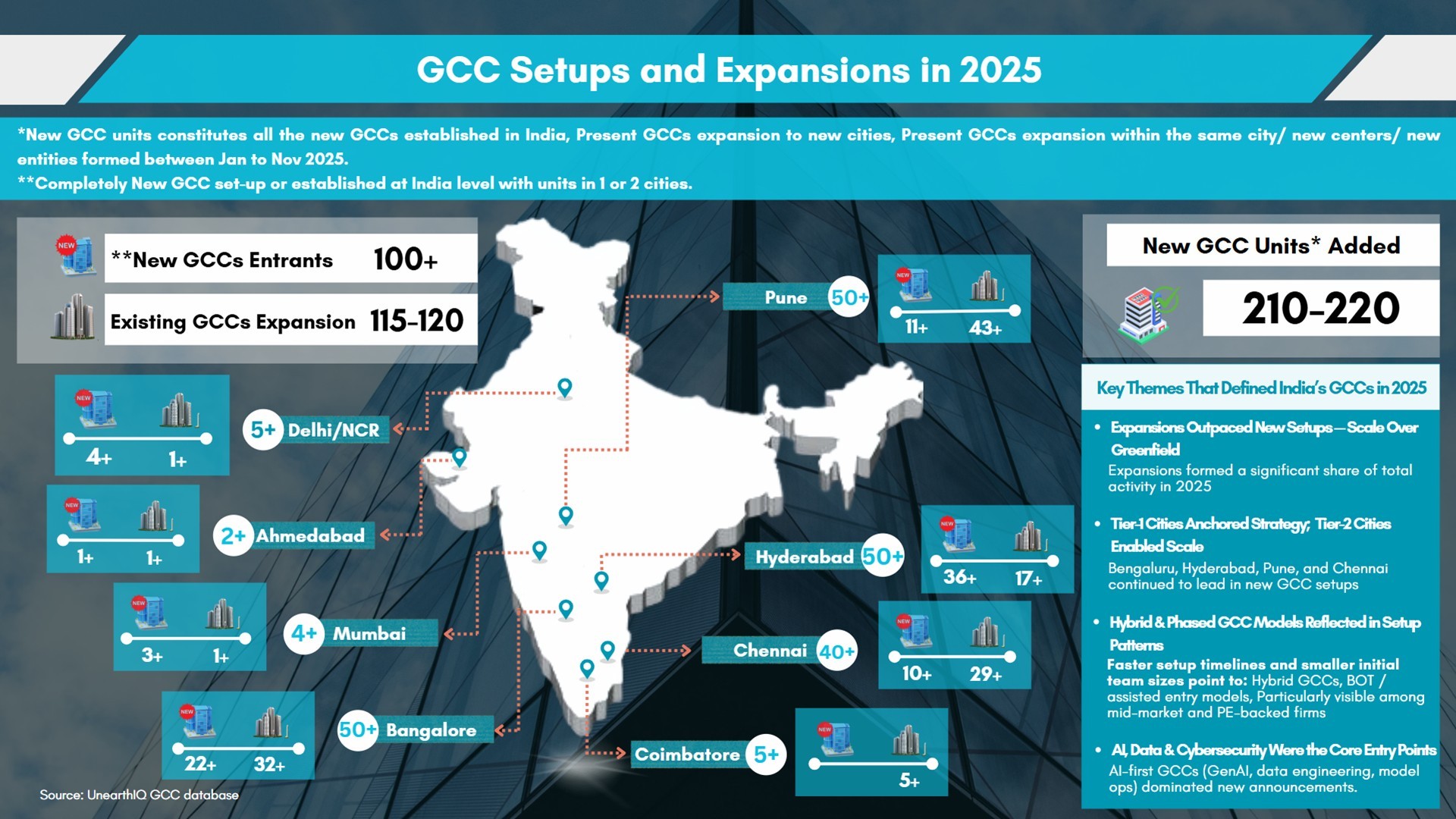
India saw 100+ new GCC entrants in 2025 — firms building India operations for the first time, with registered entities and teams on the ground. What is equally significant is that existing GCCs announced 115–120 expansion moves in the same period, pushing total new GCC unit additions to 210–220.
The fact that expansions outpaced greenfield setups is telling. It reflects growing confidence from global headquarters — existing GCCs have proven they can scale, deliver complex outcomes, and take on larger global mandates. India is increasingly seen as a long-term strategic base, not a trial destination.
Sector Mix: Where Global Firms Placed Their Bets
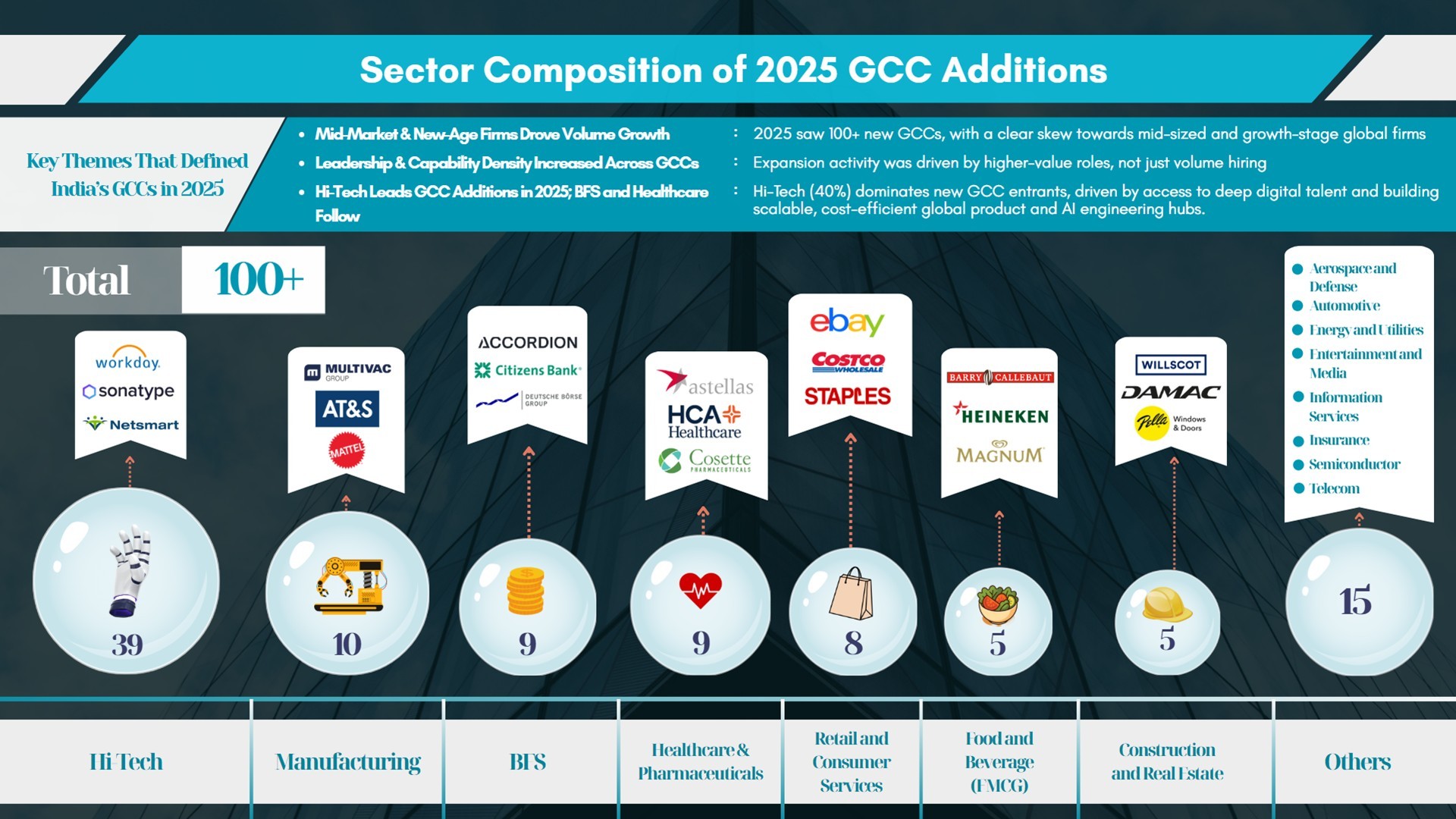
Among the 100+ new entrants, the sectoral split was clear, and data tells the story well.
Hi-Tech (39 new GCCs, ~40%): The dominant sector by a distance. Demand was driven by digital product engineering, cloud platforms, AI models, and data infrastructure. Companies such as eBay, Figma, Netsmart, Check Point Software, and Cognite are setting up new operations in India.
Manufacturing (10 new GCCs, ~10%): AT&S, MULTIVAC, and Mattel were among those establishing engineering and operations capability centres in India.
BFSI (9 new GCCs, ~9%): Citizens Bank, Accordion, and Deutsche Börse led entries, with mandates focused on risk analytics, compliance platforms, and core modernisation.
Healthcare & Pharmaceuticals (9 new GCCs, ~9%): HCA Healthcare, Astellas, and Cosette Pharmaceuticals were notable entrants, reflecting India’s growing role in digital health and regulated work.
Retail & Consumer Services (8 new GCCs, ~8%): eBay, Costco, and Staples set up technology and analytics centres in India.
Construction & Real Estate (5 new GCCs, ~5%): Willscot, DAMAC, and Pella were among the entrants in this segment.
Others — 15 new GCCs (~15%): Spanning Aerospace & Defence, Energy & Utilities, Semiconductor, Telecom, and Entertainment & Media.
Surprise packages: Food & Beverage and Retail
The HEINEKEN Company, Magnum (Unilever), Barry Callebaut, and McDonald’s all established or expanded their India GCC presence — using India as a digital supply chain, data analytics, and consumer experience hub. Similarly, Costco, Staples, and Catalyst Brands joined the India ecosystem in 2025.
These sectors were not historically prominent in GCC conversations; their arrival signals that digital transformation mandates are now cutting across industries that previously sat on the sidelines.
City Strategies: Numbers Tell the Story
The 2025 city selection was deliberate and data-backed. The GCC map shows clear leaders, steady performers, and rising tier-2 hubs.
Tier-1 Cities: Leaders and Trailing
Among Tier-1 cities, Hyderabad and Pune stood out as the most proactive markets in 2025 — not just as destinations, but as active participants in GCC growth.
Hyderabad (50+ GCC units): Led by active state-level engagement, global roadshows, and improved infrastructure investment. The Telangana government’s consistent outreach to global enterprises made Hyderabad the top destination by unit count in 2025. Notable entrants include HCA Healthcare, Costco, HEINEKEN, McDonald’s, T-Mobile, Vanguard, Netflix, and Merck MSD — across Hi-Tech, BFSI, Healthcare, and Consumer sectors.
Pune (50+ GCC units, 11 new + 43 expansions): Maharashtra’s proactive infrastructure and industry policy played a key role. Pune combined strong engineering talent with improved ease of operations. Key additions include AT&S, Bloomberg, CME Group, MetLife, Kimberly-Clark, and Warner Bros Discovery.
Bengaluru (50+ GCC units, 22 new + 32 expansions): Bengaluru’s growth in 2025 came despite infrastructure constraints and market saturation — a testament to its unmatched talent depth. It remains a magnet for all types of technology talent: product engineers, data scientists, cybersecurity professionals, and AI researchers. Companies like Google, ARM, SAP, Anthropic, Figma, and Rolls-Royce all chose or expanded in Bengaluru, drawn by the density and quality of the talent ecosystem.
Chennai (40+ GCC units): A strong performer, particularly for automotive, engineering, and financial services. BMW Techworks, American Express, State Street, Workday, and Staples were among the 2025 additions. Chennai benefits from deep engineering talent and a stable operating environment.
Delhi / NCR (5+ GCC units): Trailed the other Tier-1 cities in new GCC additions. Notable entries include OpenAI, Daikin, and Carlsberg. The market has strong potential but lags behind Bengaluru, Hyderabad, and Pune in GCC-specific infrastructure and ecosystem density.
Mumbai (4+ GCC units): Remains relevant for BFSI and professional services but saw fewer GCC setups, with Barry Callebaut, Zema Global, and Cosette Pharma among entrants. The city’s GCC activity remains constrained by real estate costs and operational complexity.
Tier-2 Cities: Established Hubs
A set of Tier-2 cities is now well-established GCC destinations with proven track records, distinct sector strengths, and growing talent pools.
Coimbatore (5+ GCC units): An emerging hub for enterprise technology and niche digital capabilities. Weaver and Tidwell, Corro Health, Banfico, and Innocap set up in Coimbatore in 2025, drawn by cost efficiency and growing tech talent.
Ahmedabad (2+ GCC units): An established BFSI and fintech hub. Cyara and Infineon Technologies set up here in 2025. The city’s proximity to major financial services networks and its strong STEM output make it a natural BFSI destination in the GCC.
Trivandrum / Kochi: Established hubs for enterprise tech and IT services. These Kerala cities benefit from high-quality engineering talent, strong retention, and government support. Increasingly used for phased GCC buildouts by mid-market firms.
Tier-2 Cities: Emerging
A second group of cities is gaining traction, attracting first-time GCC interest and being used for scale operations.
Jaipur: A strong BFSI and shared services hub, with competitive talent costs and improving digital infrastructure.
Indore: Growing recognition as a technology and analytics destination, benefiting from IIT Indore and a cost-effective talent pool.
Bhubaneswar: State government proactivity and a young engineering talent base are driving early GCC interest in this eastern market.
The dual-city model — Tier-1 for leadership and strategy, Tier-2 for execution and scale became standard practice in 2025. This is not a retreat from Tier-1 cities; it is an optimisation of the overall GCC footprint
PE-Backed and Mid-Market Firms Led New Formations
One of the defining themes of 2025 was the rise of PE-backed and mid-market firms as builders in the GCC. These are companies with revenues between $100 million and $5 billion — not Fortune 500 names, but high-growth firms backed by private equity and under pressure to build scalable global delivery infrastructure quickly.
What makes PE-backed GCCs distinctive is their completeness. Unlike large enterprises that may start with a single function, PE-backed firms tend to come in with all functions from day one, from technology, finance, HR, to operations, building a full-service India centre rather than a narrow capability team.
Examples from 2025 include Accordion (financial advisory, Hyderabad), Arch Capital (insurance, Hyderabad), Barnstorm VFX, AML RightSource, and Spaulding Ridge — all mid-market or PE-backed firms that entered India with focused, multi-function mandates.
Hybrid and Phased GCC Models: How Entry Structures Evolved
Not all GCCs were built the same way. 2025 saw a clear divergence in entry models based on who was building and how.
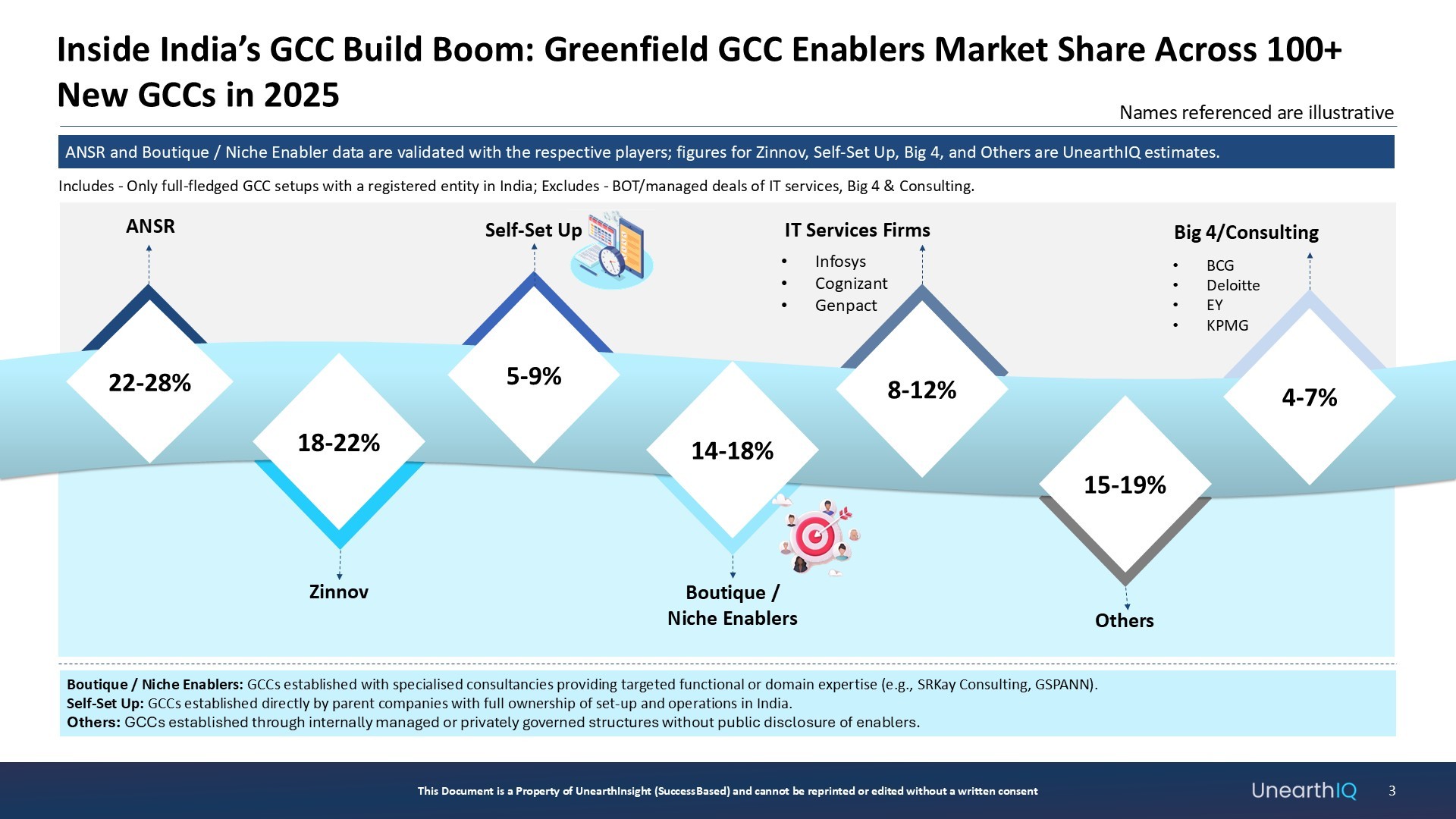
Leading GCC enablers like ANSR and Zinnov have refined their delivery models to set up full-fledged GCCs in under 90 days — from entity registration to operational teams. This speed has been a key reason why mid-market and PE-backed firms choose specialist enablers over doing it alone. ANSR, which held 22–28% of the greenfield enabler market share in 2025, and Zinnov at 18–22%, were the top two players in this space.
In contrast, GCCs enabled by IT services firms tended to follow hybrid or phased models — in which the IT partner runs the initial operations before transitioning ownership to the client. Examples from 2025 include -Lufthansa – Infosys: IT services-enabled GCC, where Infosys supported the build and operational transition.
These hybrid models reduce upfront risk and allow organisations to validate the India model before committing to full captive ownership. Big 4 and consulting firms held 4–7% of the enabler market, while IT services firms accounted for 8–12%.
AI, Data, and Cybersecurity Led Entry Mandates
Functionally, new GCCs in 2025 no longer start with IT support or back-office work. AI, data engineering, platform development, and cybersecurity emerged as the most common starting points across sectors. Entries from firms such as Anthropic, Check Point Software, Deepwatch, and Figma clearly reflect this shift.
These mandates offered immediate business impact and aligned with global transformation priorities. Leadership density was visibly higher from day one — many new GCCs launched with senior architects, product owners, and domain leads rather than building up slowly over time. This reinforces the shift from cost arbitrage to capability creation.
Unearth IQ View
2025 marked a clear inflection point for India’s GCC ecosystem. The focus moved away from rapid scale alone to capability depth and strategic relevance. Speed, ownership, and outcome-driven execution became the new benchmarks.
As the ecosystem enters 2026, the next phase will be defined by maturity — where India-based GCCs evolve into centres of global accountability, innovation leadership, and long-term value creation.